Quick addition to the list on Christmas morning. Just like the previous game on this list, this was the first title in the franchise that disappointed me, and it's probably only on here because of the title and main character.
I didn't like programed sailing, I didn't like how simple most of the landscapes were, I didn't like that the dungeons had no music, and I hated the Ocean King temple. Still, there was fun in this game. Some of the temples had neat puzzles, and the bosses were great. In particular, the ones that stretched across multiple screens. Springing up on top of that bit robot thing was one of the best moments in Zelda history.
So, fun, I guess. Not sure it should be on this list over something like Power Blade in hindsight.
It's snowing right now. A lot. It looks like this.
Watching it got me thinking. Snow is a strange thing for me now.
When you're a kid, it's the most exciting thing in the world. I grew up in Florida and Texas until I was nearly a teenager, so snow was a rare thing. When I finally lived somewhere that brought snow, it was neat. It was there to be played with, it looked beautiful, it had sledding and this quite, gorgeous calm that nothing else in the world brings.
Over time, I grew to hate snow, and I think most agree with this. It's cold, it's wet, it's inconvenient, and, worst of all, it melts. And when it melts, it just becomes ugly and muddy and no fun whatsoever. When you learn how to drive, you start to deal with ice and scraping and more things that make snow hate-able.
Snow never stopped being beautiful, though, and tonight I took a moment to stare out the window and watch the heavy snow fall, turning the world in to a blanket of calm, white, pristine beauty. I know it will eventually go away and be ugly, but, for now, I'm appreciating it. I don't know where I'll be next year, so, for all I know, this might be my last snow in a long time. Maybe ever. Right now, it brings that crazy reflective light, where the whole world is clearly visible even in the dead of night. I stood and looked up at the sky, letting the cold feathers drift on to my face, a feeling that is strangely enjoyable even with its cold wetness. I watched the heavy, puffy flakes splatter on my sleeves. I looked at how perfect everyone's Christmas decorations look under the crisp, white image, devoid of foot or tire tracks. Snow is something you grow out of, but for a brief period of time, it's something beautiful and phenomenal.
Excuse me while I go stare at frozen water's inexorable drift to the ground some more.
Drifting from the sky Upon the ground with wonder Nature's fleeting art
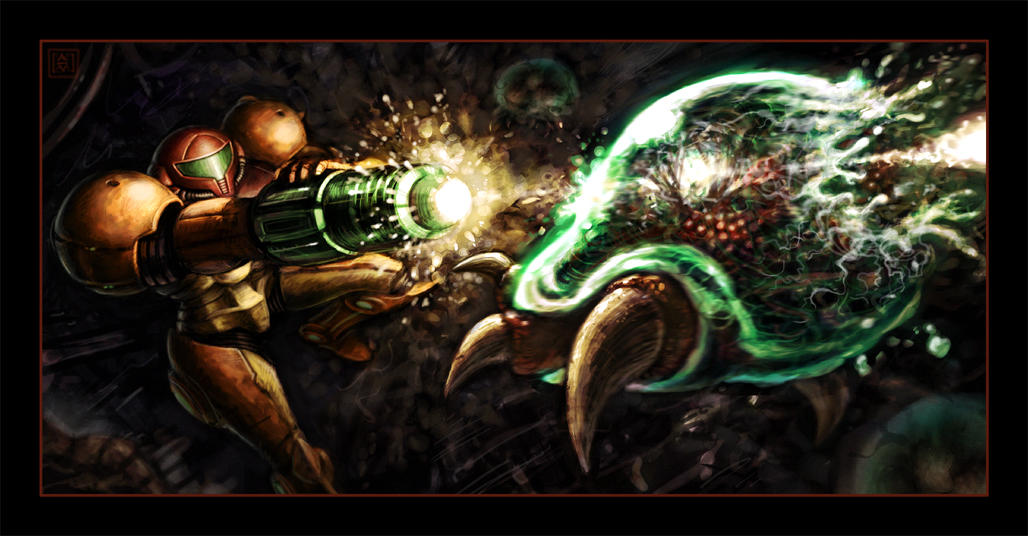
Metroid Prime: Hunters challenges your skills as you control Samus Aran, the space bounty hunter made famous in the Metroid series. A ferocious race, now extinct, has left behind relics of their once powerful warrior culture. Now bounty hunters from across the galaxy are racing against each other in order to lay claim to these relics hoping to harness their power for themselves. It's the race of a lifetime, as you guide Samus to the relics before other hunters can reach them - and use them on her (Game Box).
Yet another game I just don't feel like talking about, because it's not that awesome. In fact, now I'm not sure why it's on this list. It tries to be a mouse-and-keyboard first-person shooter, but the stylus doesn't control well enough to be a mouse, and the way you have to hold the game causes some pretty painful cramps. Not to mention the difficulty of double tapping the screen for a jump.
The plot is alright, even without metroids, and the locations are cool for a handheld. It's just so frustratingly hard to control and navigate, and the boss is the same in every level. The rival bounty hunters, though, are a nice touch, and the multiplayer was really fun. That's really probably why it's here, playing wifi multiplayer on a handheld was pretty stellar. So, Hunters isn't an upstanding part of the Metroid series, but it's still fun. I just don't have much to say about it. Onward.
Best Moment: The most memorable thing for me was when Samus first emerges from her ship. Seeing her suit rendered so well on a handheld system was cool at the time.
Best Character: Samus is always cool. Except in Other M.
The world's pulse raced with excitement! Everyone truly believed the conniving Dr. Wily had been stopped for good and imprisoned by the valiant Mega Man. Reporters jockeyed with cameramen for snapshots as the infamous Doctor hung his head while being dragged away in handcuffs. Dr. Wily would soon be behind bars. Or would he? Dr. Wily was ready for anything. He had known his dastardly plans would end in failure some day, so after six months without contact his laboratory sprung to life. Monitors whirred into action, lights flashed and the lab control panel booted up. In no time four hidden robots emerged. The robots then began a rampage in search of their master. Wily had done it again. Nothing would get in their way (Mega Man 7 Manual)!
Of the original Mega Man games, Mega Man 7 is easily one of the weakest. Yet it still makes this list, which probably tells you a whole lot of Mega Man is coming up.
MM7 was essentially an update of the classic Mega Man formula for the Super Nintendo. Mega Man X had already come out, and it was a bit different. This was a return to the series roots. A lot of what makes it fun is how much of it is good, old Mega Man stuff in 16-bit style. It absolutely does feel and play like a standard Mega Man game, just prettier, and that's a plus to me. Some people complain about the sprites, but I really like the big, colorful characters. Also, the Mega Man sprite from this game is like the go-to for sprite altering for comics and such. The game is one of the weakest, though. Most wouldn't have it anywhere near this high, and they've got some really good points. I actually don't mind having an intro sequence, but I do mind very much only getting four robot masters at a time. For me, that's a very unforgivable sin in a Mega Man game. Most of the fun is having eight levels to pick and choose from, and having to work out what order you should be doing them in by trial and error. Limiting it to four severely limits how much playing around you can do with the game, and also makes it much easier. Just writing about it now makes me angry I left this on my list. It should be banished as punishment.
There was a code where you could fix that, though. There was also an epically cool code where you could turn Shade Man's (dumb name) stage in to this:
If you don't actually recognize that, it's the music from another solid Capcom series (which just missed making this list), Ghouls n' Ghosts. I'm a big fan of homages to other games.
Unfortunately, by this time the robot masters were starting to get really stupid. Spring Man is probably the worst, but none of them are particularly interesting. Most of the powers are pretty worthless, though, other than Burst Man's nifty thing where you can trap enemies and bubbles with bombs and then shove them around until you want to push them in to something to blow up. That was fun. Oh, and the music is mostly very lame. Sort of saccharine sweet, even on stages where something more dramatic would be in order. Even the boss battle music is lame.
Still, it's Mega Man, and it looks nice, and it's fun. I'm not sure I'm comfortable putting it on this list for all the games I'm going to leave off, but it's too late to make up for that now. This list stuff is hard.
This game introduced Bass, who I believe has gone on to bigger and better things. I have never played those things.
Best Moment: Going to the Robot Master Museum and seeing suspended animations of some of the coolest bosses from past games.
Best Character: In every Mega Man game, the best character is either Dr. Wily or Rush. In this game, it's Dr. Wily.
The doctor is in! Mario takes a break from his adventuring ways and once again dons his stethoscope for a new generation of germ-battling mayhem. In addition to the classic mode of using vitamins to exterminate viruses, you'll find two battle modes and an online multiplayer mode where you can hone your skills against players from around the world (Official Website).
The first game on the list is a Wii Ware title. Weird, huh? And there's not much I can say about it. If you've never played Dr. Mario, there's something seriously very wrong with you. Frankly, I like Dr. Mario more than Tetris. I KNOW YOU MUST HATE ME NOW.
Anywho, Dr. Mario Rx is Dr. Mario, but with more options, niftier graphics, and, most importantly, online play. So it kind of represents the series on this list, as well as just being awesome on its own. Few games have consumed me the way Rx has at points. Dr. Mario alone is an addicting puzzle game, but when you add in playing people online for rankings, it just becomes absurd. Not to mention having had plenty of fun times playing with actual people in the living room, it's fun for that, too.
Seriously, though, not much to say. I love the game, but in a "I play it a lot without descriptive prose jumping out of my brain whilst doing so" way. If you have a Wii and you don't have it, you are dumb and you should correct that and we can play.
Also, obviously one of the best parts of Dr. Mario is the stellar "Fever" theme. A major reason for playing the game is just to hear the music (8-bit glory in that link). Unfortunately, I have trouble playing with the Fever music thanks to this depressing video (you have been warned, you will cry).
Damn, I paused it immediately and it still got me upset. So, yeah, every time I play on "Fever," this cartoon gets in my head. That's okay, "Chill" is sweet, too.
Best Moment: Managing to pull off the 3+ virus combo you'd been planning and raining horror upon your opponent's carefully-crafted bottle.
I'm starting to have time to kill as school mysteriously gets less busy at the end of this semester. So, I have time to spill stuff out of my brain. One thing I've always wanted to do is a write up on my 100 favorite video games ever. I have such a list I made years ago, and whenever I play a good game, I update it. So, all I have to do is write about one game a day or so. Easy.
This is obviously a terrible shot at a comprehensive list of the best games ever played. I haven't played every game ever. There are entire systems I've barely touched. This is entirely based on my subjective tastes, not factors of "greatness" or anything. So, feel free to argue and such, just not before you understand I'm not claiming my tastes reflect anything other than my tastes, and those could certainly change one day.
I will finish my top 100 NES games play through eventually, but, frankly, I've discovered so many NES games I love in the mean time, I fire it up and just want to play those.
Villanueva To be honest, I’m not entirely certain what from Villanueva’s piece I could use in Assignment #2. One term I might possibly stretch would be fictive-kinship. It’s described as “the ways in which African Americans assert the collective” through particular patterns of behavior, and Villanueva discusses the opposite of this: racelessness, where an African American chooses to break away from these behaviors. In my case, we have Lone Star Ball and the Dallas Morning News baseball blog. Both have a collective as baseball fans, and being a baseball fan has a fictive-kinship, with particular concepts and topics of discussion. The members of Lone Star Ball, however, generally break away from these traditional behaviors and try and look at things more critically and with more information, rather than the old way of “I call it like I see it.” This creates a segregation within the collective of Texas Rangers fans between the two sites. Though racelessness wouldn’t apply as race is not involved. Maybe a term like fanlessness? Multiple Choice According to Reichmuth and Werning, as cited by Sisler, stereotypical representations tend to be reproduced in more explicit forms in video games than in other media because. . .
A. Video games are generally played and created by less enlightened individuals.
B. Video games are often marketed to children, who game designers consider too young to understand concepts like racism and sexism.
C. Video games’ cultural prestige lacks in contrast to their social and economic appeal, and thus avoid the cultural discourse and media scrutiny.
D. Game designers are often young mavericks who hope to challenge the social concepts of race by daring to defy political correctness.
(C) True or False In the games Under Ash is Tahta al-Hisar, killing civilians is an element of the game with no consequence or encouragement.
Nakamura says that a menu-driven concept of race on the internet "works by progressively narrowing down the choices of subject positions. . . [and] close off the possibility of alternate hybrid definitions of racial identity" (104). With that in mind, I begin clicking through PBS's website on race to see how it does or does not narrow down our definition of race.
The first thing I encounter is a list of facts about race I can click through, including information on the variety of races and how recent of an idea race is at all. At the very least, this establishes the concept that this website disagrees with the concept of rigid, narrowly-defined race.
The next section is an activity on sorting race. There are a few races listed, narrowing down where they can be sorted. Though there may end up being a twist, this certainly does narrow down race, giving us a menu of options. Of course, there is a twist. I'm told that I was very incorrect in identifying race by looks. That said, the races are still in just five groups. Self-identification or my decision based on looks, either way, we have a menu of races, and we're not including the fluid and hybrid designations Nakamura looks for.
The quiz on human diversity offers little relevant in terms of menus until the last question. The answer to question ten involves the fact that variation is primarily within, rather than between, races. This statement doesn't break previous menus but it does speak against the idea that races can be presented on menus at all.
Other sections of the site go on to detail how race is really something that barely exists at all. Though PBS early on gives us a menu of races, it's designed for a practice to expose our preconceived notions. The website doesn't present a more varied menu from there because they are busy making the argument that presenting race on a menu is impossible.
This is something I've often wondered, but it's reinforced right now: isn't the concept of race itself an unimportant notion we should be trying to eliminate? I don't mean that as some grand philosopher looking for world peace but simply from a practical and sensible standpoint.
Works Cited
Nakamura, Lisa. Menu Driven Identities: Making Race Happen Online. New York, NY: Routledge, 2002. 103-35. eBook.
As I understand it, "identity tourism" is the concept of taking on an identity different from one's own and trying it on for size without fully experiencing that identity. The term being similar to how we might tour Detroit (not sure why) and experience Detroit for a little while, but we won't be living there to be fully affected by the poverty or the harsh winters or the constant losing of the Lions; we're just tourists. In the case of identity tourism, we are touring the identity of a race or a gender, rather than a run-down Midwest city.
Nakamura says that identity tourism allows us "to indulge in a dream of crossing over racial boundaries temporarily and recreationally" (299). She even compares the activity of surfing in cyberspace as similar to the activity of touring. She later cautions that "one of the dangers of identity tourism" is that it can reduce unfamiliar identities to us (in my case white male) to "part of a costume or masquerade. . . a 'passing' fancy" (302).
When it comes to race, Nakamura coined the term "cybertype" to describe how the race and racism are conveyed on the Internet. She describes, "cybertyping is the process by which computer/human interfaces, the dynamics and economics of access, and the means by which users are able to express themselves online interacts with the 'cultural layer' or ideologies regarding race that they bring with them into cyberspace" (3).
Cybertyping in Street Fighter 2 takes place in the form of how the various races are represented in the game. Chun-li fits the stereotype of an Asian woman appealing to a male populace of gamers. She's definitely Asian, with her dress and hair and name, though her features are just caucasian enough to remain attractive to someone who doesn't want to go all the way Asian with his tastes. At the same time that she kicks but with her Chinese cries of "yah" and "hya," she remains gorgeous with an hourglass figure and ample top half. And when she wins, she jumps up and down in a cute, innocent way with giggles and waves. She just beat a person senseless!
Other characters, of course, are cybertyped as well. A blog post is too short to go in to all of them, but Dahlsim fits a stereotype of India, looking like a Ghandi-esque mystic with skinny, stretchable limbs. He fights in a place with a vague elephant religious symbol in the background and plenty of elephants in the background. It doesn't matter than the elephants look more African than Indian because we are cybertyping here. We're creating an image of the races being represented that the user can relate to, not an image meant to be accurate.
Identity tourism is present in both gender and racial terms. Again, playing as Chun-li, I have the opportunity to experiment with playing as a woman. I don't have to take on sexism or any other number of problems that face women when I play as Chun-li. I also don't have to deal with the reality that a woman would probably face an uphill battle in a competitive fighting ring with men. I am able to tour the role of fighting girl and then step out and be myself whenever I'm ready. I'm not yet sure what Blanca says about Brazilians. . .
The same, obviously, goes for race and culture. Not only do I get to play as Chun-li (or whoever else) without facing racism that would come with being Chinese, but I get to tour representations of the various fighters' locales. As mentioned, there's "India" for Dahlsim. Chun-li fights in an overcrowded land of street vendors and bike riders. We get to tour these locals without exposure to accuracy or real dangers, and also without exposure to beauties.
Works Cited
Nakamura, Lisa. Cybertypes: Race, Ethnicity and Identity on the Internet. New York, NY: Routledge, 2002. Print. Oct. 19, 2010.
Nakamura, Lisa. "Race in/for Cyberspace: Idenity Tourism and Racial Passing on the Internet." The Cybercultures Reader. Ed. David Bell and Barbara M. Kennedy. New York, NY: Routledge, 2007. Print.
Due to the limitations of the NES, particularly early in its life span, Super Mario Bros. 2 (at least the American version which is just an alteration of Doki Doki Panic, rather than the REAL SMB2) represents the "simple abstract graphics" that Schleiner alludes to at the beginning of her essay, rather than the more refined 3D subjects like Lara Croft (222). In 8-bits, it's hard to give a girl a huge bust, a tiny waste and many other concepts of femininity that may be seen as dangerously stereotypical. There is no "female Frankenstein" to Toadstool, a.k.a. Peach in a sense we'd think of today, but while Mario presents a fat character for the user to play with, Peach is nice and thin; as thin as she should see and still be visible (223). This may simply be who the characters are, but if you make Peach fat, would the user accept that as okay? Even with primitive technology, I would imagine developers don't expect their target audience wants to be playing as a fat woman, to say nothing of how that may be seen as a derogatory joke at Peach's expense. But while there's nothing inherently wrong with having Peach in good shape, the problem comes instead with Mario, who is fat and okay. Men can be fat and happy and successful here, women cannot. Nintendo is not necessarily creating this image and, again, they're poorly-detailed 8-bit characters, but it is reflecting a standard we tend to have of our genders in society. Of course, Peach is also in a decidedly female pink dress, to reinforce that she is, in fact, a girl.
There may be something to Peach as Drag Queen, as well. In Schleiner's words, "rigid gender roles are broken down, allowing [male] players to experiment with "wearing" a feminine identity" (223). Back in these days, female main characters were rare. Metroid allowed users to play as the heroine Samus, but then they didn't even know their character was a girl until the ending (where, if they beat it fast enough, they got to see their ground breaking female hero in her bikini with her hair down). Metroid, from the same time, was significant for the female, even if you didn't know it, and SMB2 allowed you to be a female knowingly from a start. You don't have the detailed avatar of Tomb Raider here, but I certainly wouldn't rule out the appeal of some to play as an alternate gender for the novelty and experimentation of it.
I think the most significant gender make up here, however, is Princess Toadstool as Positive Role Model (Schleiner, 224). As mentioned in the previous paragraph, long before Lara Croft was presenting a heroine who women could look at in a positive light and positively be drawn in to games through, Peach was the best character in Super Mario Bros. 2. Much as Croft is not a stereotypical bimbo, Peach is not a stereotypical damsel in distress. After being saved in the previous game, she is now the choice of almost any gamer short of experienced players who have mastered the timing on Luigi's jump. While Mario is plain and boring with simple jumps, Peach can hover in a way that makes battles easier to conquer, enemies easier to avoid, gaps easier to cross and towers easier to scale. Anything our hero Mario can do, Peach can do better! While physical stereotypes are small and lost in the poor graphics, the fact that beating the game and saving the day with the girl instead of the classic hero stands out huge and helps make Peach a pretty memorable heroine and an important role model in video gaming history.
We could do a separate blog on her voice and casual dress in later games at a different time. . .
Works Cited
Schleiner, Ann-Marie. "Does Lara Croft Wear Fake Polygons? Gender and Gender-Role Subversion in Computer Adventure Games." MIT Press 34.3 (2001): 221-26. Web. 7 Oct 2010. .
Avatar dichotomizes gender in most of the same ways we always see. In the Na'vi, the men tend to lead war and battle. They tend to act with aggression and hot-headedness. The women, more often, act with compassion and reason. They are the leaders of the less violent pursuits like spirituality. Meanwhile, while Jake Sully is the prototypical male hero -- active, aggressive, head-strong, athletic and full of charisma -- Dr. Augestine falls in to many of the supporting female roles: nurturer, teacher, empathizer, naturalist.
When humans enter their avatars, they tend to take the forms we've come to associate with ideal for genders. For a woman like Augestine character, that means becoming slimmer and bustier. For a man like Sully, that meant become built and athletic. I'm not one to claim every movie should be required to buck gender conventions, but many of the gender dichotomy we view in society -- be they inherent or created -- show up in Avatar.
I shy away from the concept of "contradictory identities" as Charles Cheung uses them, because I feel humans are very diverse creatures and few personality traits are necessarily contradictory. He mentions a profile creator who "supports feminism and yet likes Sylvester Stallone's movies a lot" (277). The emphasis in the quote is mine, and I don't think supporting rights for women is inherrently contradictory to liking popcorn movies with a lot of violence and machismo; many are simply able to compartmentalize aspects of reality and enjoy or support them purely for what they are and not how they relate to other aspects.
I digress, however, and do understand what Cheung is getting at with "multiple identities," and I understand even why he uses the term contradictory, if I disagree with the connotation. In the case of Sully, he displays the single-minded "jar head" stereotype, wanting only the advancement of the goals of his superior officer and caring little for nerdy things like the scientific process (like sound record keeping). At the same time, he shows wonderment at the natural world and a genuine interest in Na'vi and their culture when they are the enemies of the Marines and the company. Further, while he's a "cutter" who wants to jump right in and get things done, his ultimate battle is against others for also being cutters, as well, diving in and trying to get to "unobtanium" in less-than-careful ways; his very nature is similar to that he fights against.
Also, I don't think Jake Sully is a particularly deep character, so I don't think he offers many great opportunities for studying multiple identities. He presents himself as a good Marine to his superior officer and presents himself as a good Na'vi to the Na'vi; he just changes which identity he likes more over the course of the movie.
Avatars are like personal web pages in that they can give humans the emancipation to explore Pandora in ways they couldn't otherwise, without breath masks and with the physical abilities to roam the terrain and experience a nature that is beyond human limitations. Unlike personal web pages, however, the operator of the avatar doesn't have the freedom to adjust his "profile" the way he can on a web page. What he has is what's created from his DNA; it's a different creature, but it's still based on himself.
Works Cited
Avatar. Dir. James Cameron." Twentieth Century Fox Film Corperation: 2009, Film.
Cheung, Charles. "Identity Construction and Self-Presentation on Personal Homepages: Emancipatory Potentials and Reality Constraints." The Cybercultures Reader. Ed. David Bell and Barbara M. Kennedy. New York, NY: Routledge, 2007. Print.
This was one of my first attempts at shifting the perspective of writing, something I think could be a nice tool in the future.
This is one of the more interesting and convincing albums this process has come up with for me yet. It just feels like an album cover, right down to the couple in the front wearing headphones.
Unfortunately, dbClifford is a real singer, which makes this actually less fun.
The iFruit series of comics from the strip FoxTrot displays what Deborah Lupton calls “the humanized computer” (426). Lupton primarily references advertising as a location for making computers seem “humanized,” but the same ideology employed by advertisements is employed else where in culture. More iFruit strips can be seen here. In the case of FoxTrot, the Foxes' iFruit communicates like humans. It talks, it feels and it thinks. In the strip above, it shows emotion by wanting a hug. In the strip below, it expresses its desire to be upgraded. Much like the ads Lupton discusses make computers seem longing for their “new toys,” Bill Amend has the Fox’s iFruit literally asking for its upgrades in the form of a Christmas list. And when the computer is threatened with not getting its Christmas wish fulfilled, it accesses another human trait: blackmail. It’s never explained why the iFruit can talk and how this computer has emotions, it’s just left to be understood by the reader. And the reason that’s okay is because our society has been conditioned to think of computers as living, thinking, learning things. Human-like machines, not just tools that sit on our desks. Though none of us have a computer that behaves as humanly as advertisements or FoxTrot act, it’s a concept we mostly understand and accept without even thinking. Some of this is due to how fascinating the technology still is to us, and some is from the powers that be that Lupton discusses presenting humanized computers to us. Once you see it enough, it’s just a part of their cultural identity to you. On a side note, another ideology of Lupton's can be seen in FoxTrot, and that's "the hacker's body" (425). Jason Fox fits the hacker stereotype, purposefully, to the letter. He has thick glasses, unkempt hair, poor social skills, a gigantic intellect and an addiction to his technology. His interests are geeky and his knowledge beyond his years, and yet much of his personality is immature.
I think the most significant thing I've learned about digital culture in this class so far is the fact that everything is designed for a purpose, but that design is not necessarily the way things have to be or should have been. Further, that design is something that can create a digital divide. An example is from Selfe and Selfe's "Politics of the Interface." They discuss the GUI interface of most computers as a white collar office setting, with a desktop and files and other sorts of things someone from the background that most with computers are familiar with (486-87). It had never crossed my mind this wasn't "the way things are supposed to be" and instead is "the way things happen to be" and an element of digital division. Remembering what's conveyed by style choices may not be appropriate for all current and future intended audiences is something I intend to take from this class.
Another album cover for you. I'm seeing this album being a solo male artist with introspective, often depressing, themes. Why his stage name comes from a Sumerian king, I don't know.
One of the good things to come out of 4chan is the "random album cover art" pass time. If you're unfamiliar with it, you produce an album cover with these simple steps:
Go to Flickr and pick the 5th photo under the "interesting in the last 7 days" category. This is your image.
Go to Wikipedia and click random page. This is your band name.
Go to Wikiquote and click random page. Use the last 3-5 words in the first quote. This is your title.
Combine them in Gimp or Photoshop or something and you have your album cover.
I intend to post the cool ones I come up with in the future here. This is today's.
In Zygmunt Bauman’s theory of web communities as “pegs” and David Bell’s critique, one sentence stood out to me:
(Peg communities are) sites where people can hang their interests or obsessions, their enthusiasms or worries, and around which they can – or might – try to build up something collective, albeit instrumentally and ephemerally.
(Bell, 257)
Bell finds Bauman’s opinion of web communities to be gloomy and looks for a rebuttal, but I focus rather on the word “can” in his description of Bauman. And, frankly, I agree with Bauman: a web community indeed can be a place we temporarily hang a superficial aspect of ourselves, only to take it down when we want to go elsewhere.
On (extreme) example is that of the Internet troll. Consider the posting history of PumbasNakasak of the WDW Magic message boards. An very open troll, his entire purpose the forum is to get reactions out of posters by post intentional controversial – and only occasionally rational – opinions. He reveals very little of himself or his personal life and creates no deep connections with the community. If he ever becomes board, like most trolls, he can leave with likely little if any emotional ties being severed.
The peg concept doesn’t only extend to trolls, of course. Anyone can be who and what they want to be – their partial selves or something completely new – in a web community and then take that off the peg and leave whenever they want. The superficial and transient bonds mentioned from Bauman can apply.
That said, Bell’s arguments against Bauman that online communities are not necessarily “a togetherness of loners” also hold water (258). His belief they can be like Anthony Giddens’ “pure relationships,” where social relation exists for the sake of both (or all) parties to deliver enough satisfaction for both (or all) to stay in can apply, as well. I am a member of many communities where I consider the others dear and close friends on par with those in Real Life, and this is despite having a healthy Real Life social life. Not all use their communities as peg boards, but that doesn’t mean Bauman is incorrect in saying it’s an aspect of web communities. It all depends on what you’re there for.
As far as the web communities I’ll be using for Assignment #2, I’ve chosen Lone Star Ball (www.lonestarball.com), Baseball Time in Arlington (www.bbtia.com), and the Dallas Morning News Texas Rangers blog (rangersblog.dallasnews.com); three different Texas Rangers blogs. I choose these three communities because I have extensive experience with all three, including a very deep understanding of the first as a frequent contributor and writer for other websites from its same network. Their format, style, communities and topic have dominated my recent Internet experiences, making for an easier topic than picking three communities I know little about. Further, while each covers the same topic and have many face-value similarities, they become very different websites and communities as one dives deeper in to their content.
Works Cited
Baseball Time in Arlington. 9/15/2010. Web. 16 Sep 2010. .
Bell, David. "Webs As Pegs." The Cybercultures Reader. Ed. David Bell and Barbara M. Kennedy. New York, NY: Routledge, 2007. Print.
This was the first time I'd been to Yahoo! in a while, and I immediately remember why: overload. Consider just this 500x500 screenshot of the home page. In this little snapshot of what Yahoo! greets us with, you have no less than five different elements competing for your attention, none flowing with eachother with any sense of cohesion or visual flow. You have a seemingly random assortment of videos, news links, "Trends" and an ad. Brunett and Marshall are accurate that the goal is to pull users along to the next location, my reaction to Yahoo! is more one of frightened retreat (100). Opening such a noisy website that requires actual effort for me to figure out what is actually being linked to is certainly no invitation to me. Certainly Yahoo! is successful, but when we compare it to Google's home page, maybe we can get an idea for why Google is more successful. I liked the wording Burnett and Marshall had for one particular feature of a website like Yahoo!, however:
Augmenting these techniques of providing interconnection among users of Yahoo! are teh accordion-like hyperlink extrapolations of stories from a single site. The accordion-efect is not so much driven by linearity, but a wider reach of potential interconnection (101).
I'm focusing on the discussion of what they call "the accordion effect," which is a phenomena I definitely recognize from the internet, something that can keep me on Wikipedia or IMDb or ESPN for hours chasing links. It's not something that I think Yahoo! does particularly well, however.
I see "What Not To Buy At Target." I don't shop at Target, but I'm mildly curious as to what I shouldn't buy there. Now on most websites that would keep me moving, they would have a clear list of related links somewhere. The have "More From CBSMoneyWatch.com," but there are a mere three links, only one of which particularly relevant to the article at hand (and they all take me away from Yahoo!). The links within the text are merely citations, rather than being used for the purpose of creating a next net space to read through. At the bottom, we have the most popular stories on Yahoo!, but they are unrelated to this link. So, once I've gone in to "What Not To Buy At Target," it would only be sheer coincidence that would get me moving along to another website. Other websites provide a wealth of links, either by connecting them to words in the primary text or linking to related websites and stories, but Yahoo! presents me with more of a dead end, making it more likely my mouse pointer will wander towards the URL bar to head towards another website.
Far be it for me to give Yahoo! business advice, but there webpage is and always has been, for me, uninviting and poorly designed in regards to keeping me around if I give it a chance.
Works Cited
Burnett, Robert, and Marshall P. David. Web Theory: An Introduction. 1st ed. New York, NY: Routledge, 2003. 81-104. eBook.
Mark Warschauer makes argues, “a digital divide is marked not only by physical access to computers and connectivity, but also by access to the additional resources that allow people to use technology well,” (par. 21). In this case, the digital divide is the gap in access to and ability to competently use technology between different cultures, groups and people. He further argues the divide, “is not a binary division between information ‘haves and "have-nots,’ but rather a range of access and ability; there’s a gray area to the divide, not simply the blacks who can use computers and the whites who can’t (par. 22). By this definition, which I find wholly reasonable, the digital divide can be found between just about any group you find. My neighbor who shares a computer with his family that he doesn’t really know how to use on a dial-up internet has less access to a form of information technology than I do with my brand-new laptop I’ve conformed to do what I want on my high-speed wireless internet. When discussing the digital divide, it seems to me, someone just beginning to learn of the concept in some depth, that the degree of the divide and how much the specific gap in question matters is important to find, rather than merely stating where there is and is not a divide and treating all divides as an equal problem.
In Selfe and Self discuss a disconnect created with the common desktop interface designed around professional office symbols and materials (486). I’m not readily sure of what sort of metaphors would work better for an operating system, however, for two reason. The first is that I come from a fairly white-collar background and grew up around computers, so the interface is natural to me and thinking of anything different is difficult. The second is that many changes would mean making a massive change to computer norms from the ground up, such as eliminating the idea of “folders” as a very basic term.
One that could work in the interest of being creative, however, might be a building. “Windows” (not to borrow the term from Microsoft) could represent windows in to the building, and you choose the window for the “room” you want, or what sort of use you plan to make of the computer. Inside the individual rooms could be a simple chart displaying the programs available, with stored information simply in scrollable, sortable and searchable list formats. This may well be over-thinking it and is certainly likely missing some of the issues, but a building is something just about everyone has experience with in their lives, and the idea of going inside of buildings to get to what is inside is intuitive. There could even be a prompt when the system is first started asking what sort of “look” the interface inside the “rooms” could have as far as reflecting areas of work, following the ideas presented in Self and Selfe of kitchen counters and fast food restaurants if such a thing would be successful (486-7).
Works Cited
Selfe, and Selfe. Politics of the Interface. 1994. 485-88.
Warschauer, Mark. "Reconceptualizing the Digital Divide." First Monday 7.7 (2002): n. pag. Web. 2 Sep 2010. .
 Quick addition to the list on Christmas morning. Just like the previous game on this list, this was the first title in the franchise that disappointed me, and it's probably only on here because of the title and main character.
 Still, there was fun in this game. Some of the temples had neat puzzles, and the bosses were great. In particular, the ones that stretched across multiple screens. Springing up on top of that bit robot thing was one of the best moments in Zelda history.